Thursday, 6 February 2020

Short Shunt Compound Wound Generator

Short Shunt Compound Wound Generator

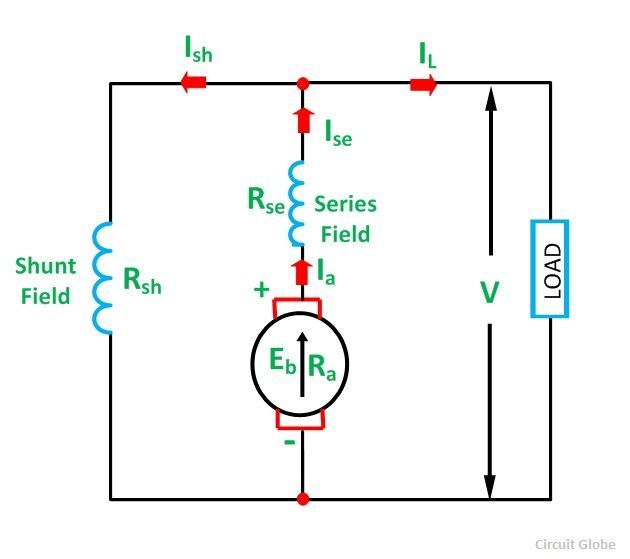
In a Short Shunt Compound Wound Generator, the shunt field winding is connected in parallel with the armature winding only. The connection diagram of short shunt wound generator is shown below.
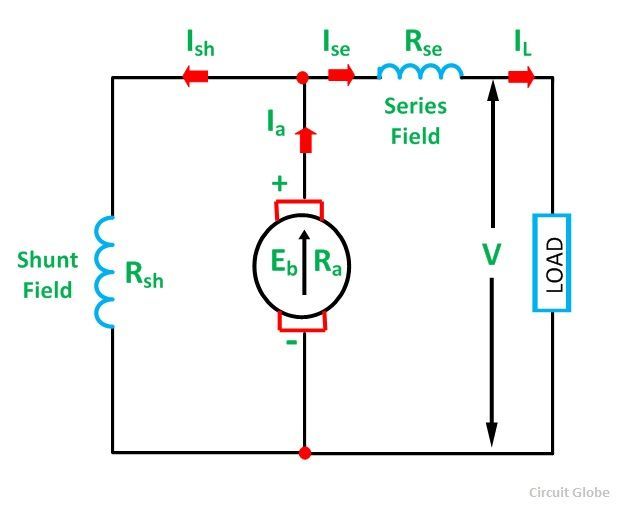
compound wound generator fig 2
Short Shunt Compound Wound Generator
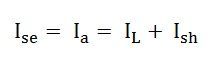
Series field current is given as
compound-wound-generator-eq5j
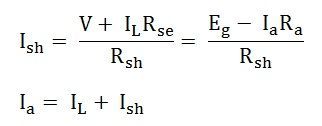
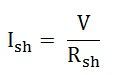
Shunt field current is given as
compound-wound-generator-eq6
Terminal voltage is given as
compound-wound-generator-eq7
If the brush contact drop is included, the terminal voltage equation is written as
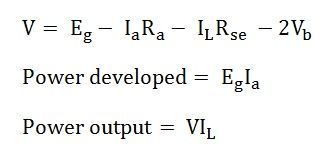
compound-wound-generator-eq8
In this type of DC generator, the field is produced by the shunt as well as series winding. The shunt field is stronger than the series field. If the magnetic flux produced by the series winding assists the flux produced by the shunt field winding, the generator is said to be Cumulatively Compound Wound generator.
If the series field flux opposes the shunt field flux, the generator is said to be Differentially Compounded.

Compound Wound Generator

Compound Wound Generator

In a Compound Wound Generator, there are two sets of the field winding on each pole. One of them is connected in series having few turns of thick wire, and the other is connected in parallel having many turns of fine wire with the armature windings. In other words, the generator which has both shunt and series fields is called the compound wound generators.
If the magnetic flux produced by the series winding assists the flux produced by the shunt winding, then the machine is said to be cumulative compounded. If the series field flux opposes the shunt field flux, then the machine is called the differentially compounded.
It is connected in two ways. One is a long shunt compound generator, and another is a short shunt compound generator. If the shunt field is connected in parallel with the armature alone then the machine is called the short compound generator. In long shunt compound generator, the shunt field is connected in series with the armature. The two types of generators are discussed below in details.

Long Shunt Compound Wound Generator

In a long shunt wound generator, the shunt field winding is parallel with both armature and series field winding. The connection diagram of long shunt wound generator is shown below.
compound wound generator fig 1
Long Shunt Compound Wound Generator
Shunt field current is given as
compound-wound-generator-eq1
Series field current is given as

Compound Wound Generator

In a Compound Wound Generator, there are two sets of the field winding on each pole. One of them is connected in series having few turns of thick wire, and the other is connected in parallel having many turns of fine wire with the armature windings. In other words, the generator which has both shunt and series fields is called the compound wound generators.
If the magnetic flux produced by the series winding assists the flux produced by the shunt winding, then the machine is said to be cumulative compounded. If the series field flux opposes the shunt field flux, then the machine is called the differentially compounded.
It is connected in two ways. One is a long shunt compound generator, and another is a short shunt compound generator. If the shunt field is connected in parallel with the armature alone then the machine is called the short compound generator. In long shunt compound generator, the shunt field is connected in series with the armature. The two types of generators are discussed below in details.
Contents:

Long Shunt Compound Wound Generator

In a long shunt wound generator, the shunt field winding is parallel with both armature and series field winding. The connection diagram of long shunt wound generator is shown below.
compound wound generator fig 1
Long Shunt Compound Wound Generator
Shunt field current is given as
compound-wound-generator-eq1
Series field current is given as
compound-wound-generator-eq2
Terminal voltage is given as
ound-wound-generator-eq3
If the brush contact drop is included, the terminal voltage equation is written as
compound-wound-generator-eq4

Series Wound Generator

Series Wound Generator

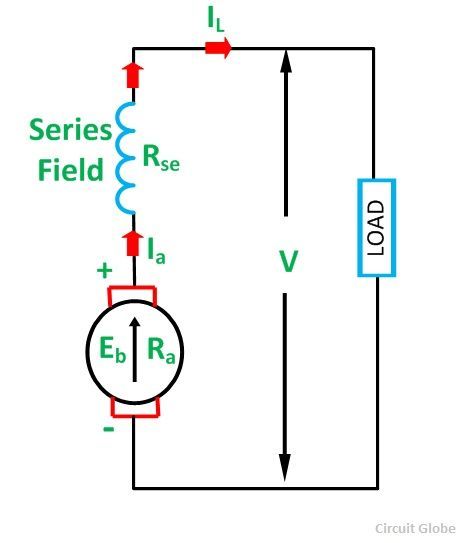
A series-wound generator the field coils are connected in series with the armature winding. The series field winding carries the armature current. The series field winding consists of a few turns of wire of thick wire of larger cross-sectional area and having low resistance usually of the order of less than 1 ohm because the armature current has a very large value.
Its convectional diagram is shown below.
types-of-dc-generator-fig-3
Series Wound DC Generator
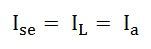
Series field current is given as
types-of-DC-generator-eq8
Rse is known as the series field winding resistance.
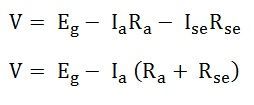
Terminal voltage is given as
types-of-DC-generator-eq9
If the brush contact drop is included, the terminal voltage equation is written as
types-of-DC-generator-eq10-
The flux developed by the series field winding is directly proportional to the current flowing through it. But it is only true before magnetic saturation after the saturation flux becomes constant even if the current flowing through it is increased.

Self Excited DC Generator

Self Excited DC Generator

Self-excited DC Generator is a device, in which the current to the field winding is supplied by the generator itself. In self-excited DC generator, the field coils mat be connected in parallel with the armature in the series, or it may be connected partly in series and partly in parallel with the armature windings.
The self-excited DC Generator is further classified as

Shunt Wound Generator

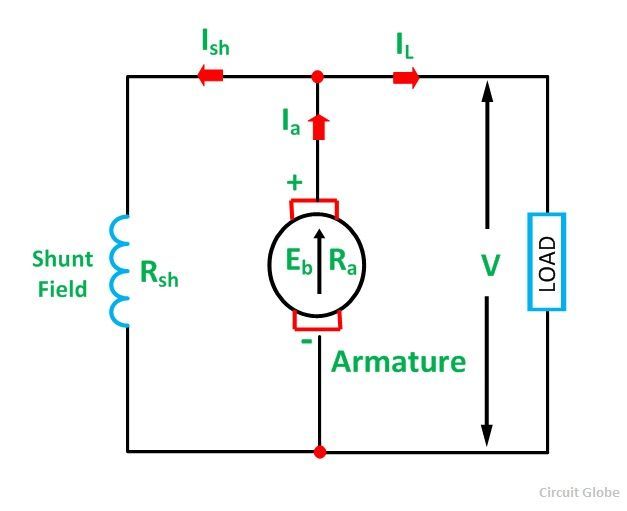
In a shunt wound generator, the field winding is connected across the armature winding forming a parallel or shunt circuit. Therefore, full terminal voltage is applied across it. A very small field current Ish, flows through it because this winding has many turns of fine wire having very high resistance Rsh of the order of 100 ohms.
The connection diagram of shunt wound generator is shown below.
types-of-dc-generator-fig-2
Shunt Wound DC Generator
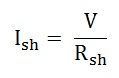
Shunt field current is given as
types-of-DC-generator-eq4
Where Rsh is the shunt field winding resistance.
The current field Ish is practically constant at all loads. Therefore, the DC shunt machine is considered to be a constant flux machine.
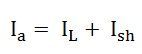
Armature current is given as
types-of-DC-generator-eq5
Terminal voltage is given by the equation shown below.
types-of-DC-generator-eq6
If the brush contact drop is included, the equation of the terminal voltage becomes
types-of-DC-generator-eq7

Separately Excited DC Generator

Separately Excited DC Generator

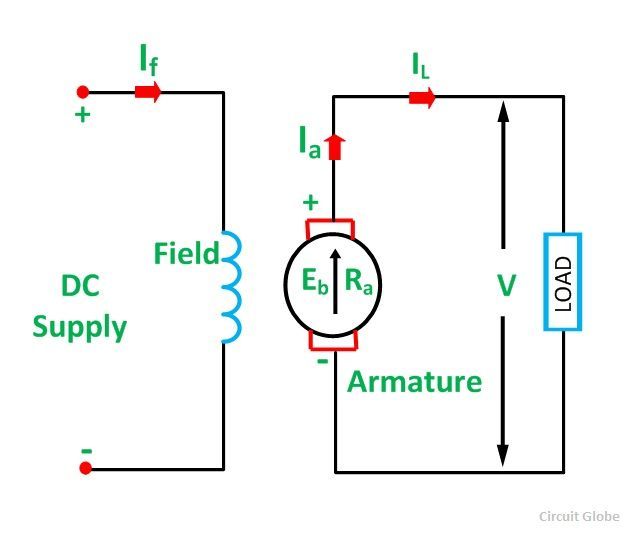
A DC generators whose field winding or coil is energised by a separate or external DC source is called a separately excited DC Generator. The flux produced by the poles depends upon the field current with the unsaturated region of magnetic material of the poles. i.e. flux is directly proportional to the field current. But in the saturated region, the flux remains constant.
The figure of self-excited DC Generator is shown below.
types-of-dc-generator-fig-1

Ia = IL where Ia is the armature current and IL is the line current.
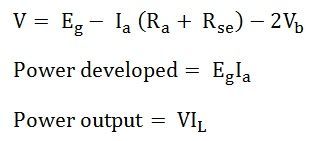
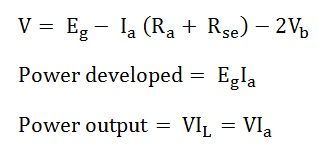
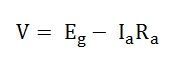
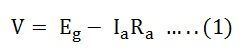
Terminal voltage is given as
types-of-DC-generator-eq1-compressor
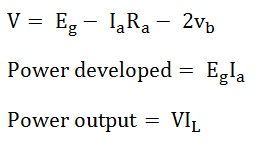
If the contact brush drop is known, then the equation (1) is written as
types-of-DC-generator-eq2
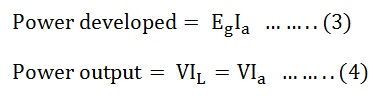
The power developed is given by the equation shown below.
types-of-DC-generator-eq3-
Power output is given by the equation (4) shown above.


Applications of DC Generators


Applications of DC Generators


Separately Excited DC Generators
·         Separately excited DC Generators are used in laboratories for testing as they have a wide range of voltage output.
·         Used as a supply source of DC motors.
Shunt wound Generators
·         DC shunt wound generators are used for lighting purposes.
·         Used to charge the battery.
·         Providing excitation to the alternators.
Series Wound Generators
·         DC series wound generators are used in DC locomotives for regenerative braking for providing field excitation current.
·         Used as a booster in distribution networks.
·         Over compounded cumulative generators are used in lighting and heavy power supply.
·         Flat compounded generators are used in offices, hotels, homes, schools, etc.

Applications of DC Motors


Applications of DC Motors

The main applications of the three types of direct current motors are given below.

Series Motors

The series DC motors are used where high starting torque is required, and variations in speed are possible. For example – the series motors are used in Traction system, Cranes, air compressors, Vaccum Cleaner, Sewing machine, etc.

Shunt Motors

The shunt motors are used where constant speed is required and starting conditions are not severe. The various applications of DC shunt motor are in Lathe Machines, Centrifugal Pumps, Fans, Blowers, Conveyors, Lifts, Weaving Machine, Spinning machines, etc.

Compound Motors

The compound motors are used where higher starting torque and fairly constant speed is required. The examples of usage of compound motors are in Presses, Shears, Conveyors, Elevators, Rolling Mills, Heavy Planners, etc.
The small DC machines whose ratings are in fractional kilowatt are mainly used as control device such in Techno generators for speed sensing and in Servo motors for positioning and tracking.