Thursday, 6 February 2020

Self Excited DC Generator

Self Excited DC Generator

Self-excited DC Generator is a device, in which the current to the field winding is supplied by the generator itself. In self-excited DC generator, the field coils mat be connected in parallel with the armature in the series, or it may be connected partly in series and partly in parallel with the armature windings.
The self-excited DC Generator is further classified as

Shunt Wound Generator

In a shunt wound generator, the field winding is connected across the armature winding forming a parallel or shunt circuit. Therefore, full terminal voltage is applied across it. A very small field current Ish, flows through it because this winding has many turns of fine wire having very high resistance Rsh of the order of 100 ohms.
The connection diagram of shunt wound generator is shown below.
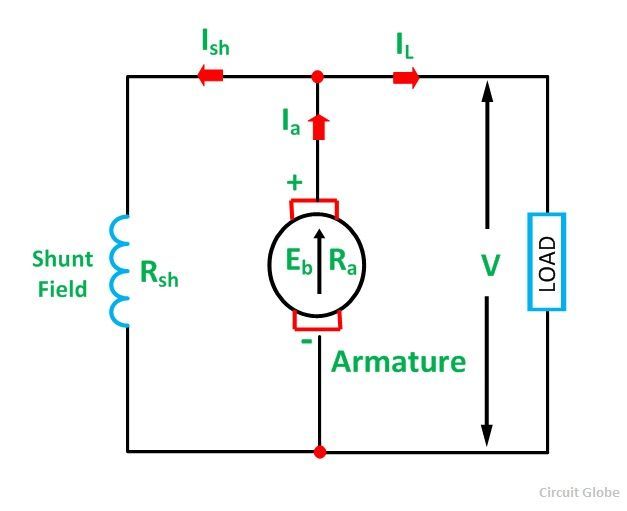
types-of-dc-generator-fig-2
Shunt Wound DC Generator
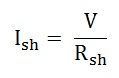
Shunt field current is given as
types-of-DC-generator-eq4
Where Rsh is the shunt field winding resistance.
The current field Ish is practically constant at all loads. Therefore, the DC shunt machine is considered to be a constant flux machine.
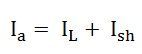
Armature current is given as
types-of-DC-generator-eq5
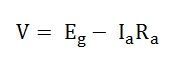
Terminal voltage is given by the equation shown below.
types-of-DC-generator-eq6
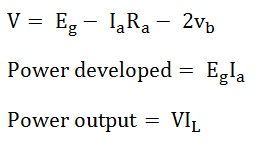
If the brush contact drop is included, the equation of the terminal voltage becomes
types-of-DC-generator-eq7

Separately Excited DC Generator

Separately Excited DC Generator

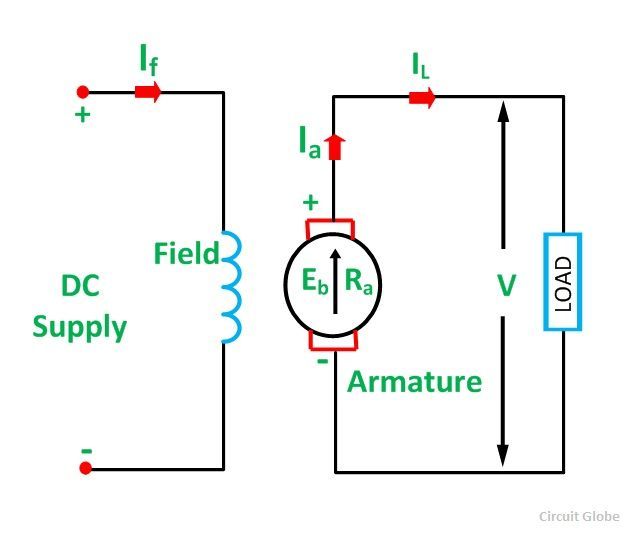
A DC generators whose field winding or coil is energised by a separate or external DC source is called a separately excited DC Generator. The flux produced by the poles depends upon the field current with the unsaturated region of magnetic material of the poles. i.e. flux is directly proportional to the field current. But in the saturated region, the flux remains constant.
The figure of self-excited DC Generator is shown below.
types-of-dc-generator-fig-1

Ia = IL where Ia is the armature current and IL is the line current.
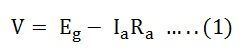
Terminal voltage is given as
types-of-DC-generator-eq1-compressor
If the contact brush drop is known, then the equation (1) is written as
types-of-DC-generator-eq2
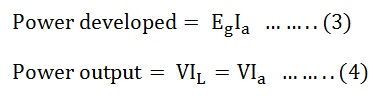
The power developed is given by the equation shown below.
types-of-DC-generator-eq3-
Power output is given by the equation (4) shown above.


Applications of DC Generators


Applications of DC Generators


Separately Excited DC Generators
·         Separately excited DC Generators are used in laboratories for testing as they have a wide range of voltage output.
·         Used as a supply source of DC motors.
Shunt wound Generators
·         DC shunt wound generators are used for lighting purposes.
·         Used to charge the battery.
·         Providing excitation to the alternators.
Series Wound Generators
·         DC series wound generators are used in DC locomotives for regenerative braking for providing field excitation current.
·         Used as a booster in distribution networks.
·         Over compounded cumulative generators are used in lighting and heavy power supply.
·         Flat compounded generators are used in offices, hotels, homes, schools, etc.

Applications of DC Motors


Applications of DC Motors

The main applications of the three types of direct current motors are given below.

Series Motors

The series DC motors are used where high starting torque is required, and variations in speed are possible. For example – the series motors are used in Traction system, Cranes, air compressors, Vaccum Cleaner, Sewing machine, etc.

Shunt Motors

The shunt motors are used where constant speed is required and starting conditions are not severe. The various applications of DC shunt motor are in Lathe Machines, Centrifugal Pumps, Fans, Blowers, Conveyors, Lifts, Weaving Machine, Spinning machines, etc.

Compound Motors

The compound motors are used where higher starting torque and fairly constant speed is required. The examples of usage of compound motors are in Presses, Shears, Conveyors, Elevators, Rolling Mills, Heavy Planners, etc.
The small DC machines whose ratings are in fractional kilowatt are mainly used as control device such in Techno generators for speed sensing and in Servo motors for positioning and tracking.


classification of dc generator


Classifications of DC machines : (DC Motors and DC Generators)

Each DC machine can act as a generator or a motor. Hence, this classification is valid for both: DC generators and DC motors. DC machines are usually classified on the basis of their field excitation method. This makes two broad categories of dc machines; (i) Separately excited and (ii) Self-excited.
§  Separately excited DC machines: In separately excited dc machines, the field winding is supplied from a separate power source. That means the field winding is electrically separated from the armature circuit. Separately excited DC generators are not commonly used because they are relatively expensive due to the requirement of an additional power source or circuitry. They are used in laboratories for research work, for accurate speed control of DC motors with Ward-Leonard system and in few other applications where self-excited DC generators are unsatisfactory. In this type, the stator field flux may also be provided with the help of permanent magnets (such as in permanent magnet DC motors). PMDC (permanant magnet DC) motors are popularly used in small toys, e.g. a toy car.
§  Self-excited DC machines: In this type, field winding and armature winding are interconnected in various ways to achieve a wide range of performance characteristics (for example, field winding in series or parallel with the armature winding).
In a self-excited type of DC generator, the field winding is energized by the current produced by themselves. A small amount of flux is always present in the poles due to the residual magnetism. So, initially, current induces in the armature conductors of a dc generator only due to the residual magnetism. The field flux gradually increases as the induced current starts flowing through the field winding.

Self-excited machines can be further classified as –
§  Series wound dc machines – In this type, field winding is connected in series with the armature winding. Therefore, the field winding carries whole of the load current (armature current). That is why series winding is designed with few turns of thick wire and the resistance is kept very low (about 0.5 Ohm).
§  Shunt wound dc machines – Here, field winding is connected in parallel with the armature winding. Hence, the full voltage is applied across the field winding. Shunt winding is made with a large number of turns and the resistance is kept very high (about 100 Ohm). It takes only small current which is less than 5% of the rated armature current.
§  Compound wound dc machines – In this type, there are two sets of field winding. One is connected in series and the other is connected in parallel with the armature winding. Compound wound machines are further divided as -
§  Short shunt – field winding is connected in parallel with only the armature winding
§  Long shunt – field winding is connected in parallel with the combination of series field winding and armature winding

classification of dc generator sem/m3 soan


dc generator soan 2020/kd

DC Generator

A dc generator is an electrical machine which converts mechanical energy into direct current electricity. This energy conversion is based on the principle of production of dynamically induced emf. This article outlines basic construction and working of a DC generator.

Construction of a DC machine:

Note: A DC generator can be used as a DC motor without any constructional changes and vice versa is also possible. Thus, a DC generator or a DC motor can be broadly termed as a DC machine. These basic constructional details are also valid for the construction of a DC motor. Hence, let's call this point as construction of a DC machine instead of just 'construction of a dc generator'.

Construction of a DC machine (DC Generator and DC Motor)